...
Equip your practice: 50% Off the TherapyByPro Whole Shop Bundle (1,000+ Evidence-Based Tools) → Get Access Now

Cognitive Behavioral Therapy (CBT) places a strong emphasis on the relationship between beliefs, predictions, and lived experience. Rather than treating thoughts as fixed truths, CBT views them as testable hypotheses that can be evaluated through structured real-world experiences. Within this framework, behavioral experiments are used to move clients beyond intellectual insight and into experiential learning.

This approach is particularly useful when clients hold rigid predictions about themselves, other people, or the consequences of their actions. These predictions often remain unchallenged because they are reinforced by avoidance, safety behaviors, or limited exposure to disconfirming evidence.

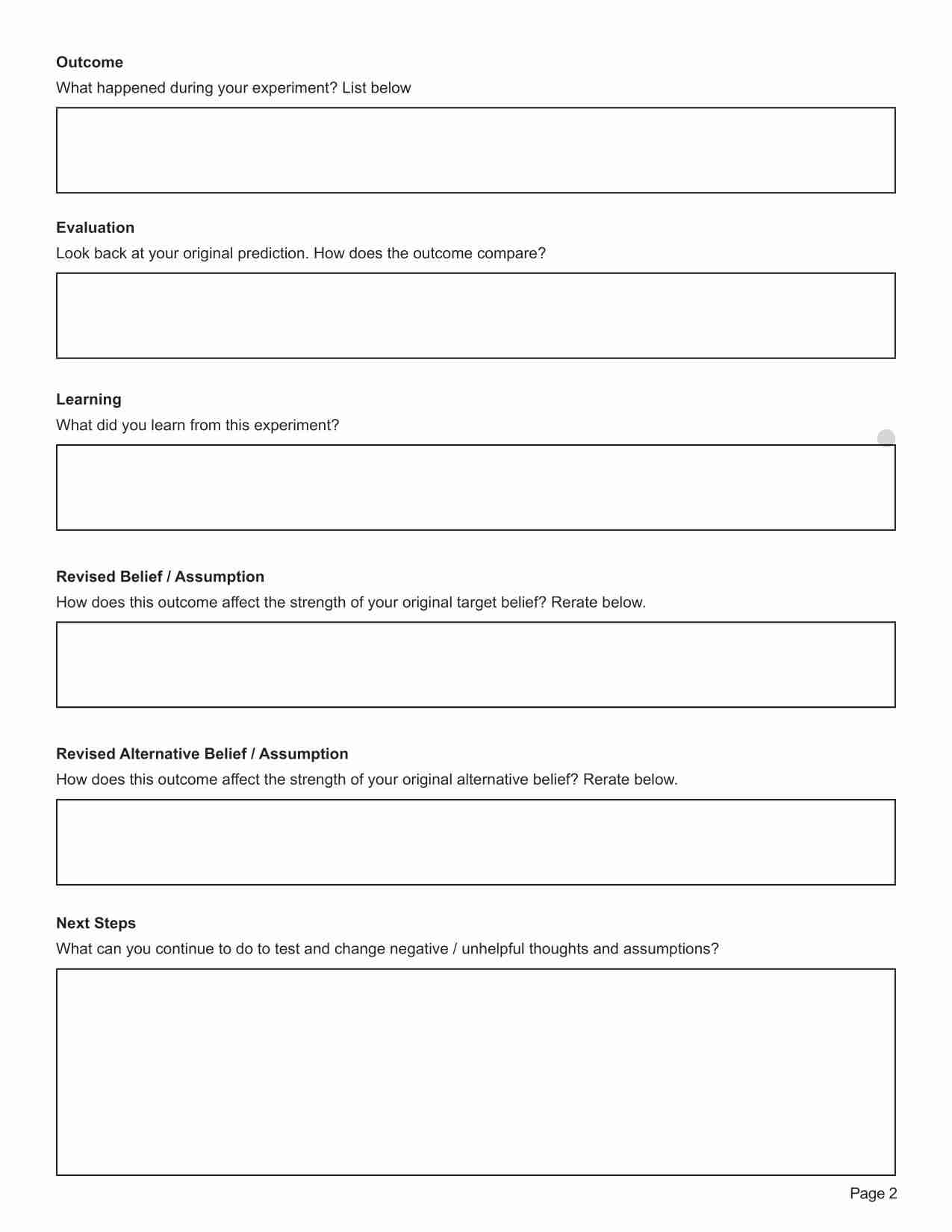
The CBT Behavioral Experiment Worksheet is designed to operationalize this process in a structured, repeatable format. It supports clinicians in helping clients identify a specific belief, generate an alternative perspective, and design a real-world test of that belief. The emphasis is not on proving thoughts “right or wrong,” but on gathering lived evidence that can refine thinking over time.

By explicitly comparing predicted outcomes with actual outcomes, clients begin to develop cognitive flexibility, reduce reliance on avoidance strategies, and build more adaptive interpretations of internal and external experiences.

This template is part of the CBT Worksheets Bundle. Explore our complete collection of CBT tools and Resources.
- +

Want to see how our worksheets work? Download our FREE Brief Mental Status Exam

secure-img
instant-img
satisfaction-img
avg-img
csrmr-img

Get a Closer Look at What's Included

Click on an image below to get a closer look at what's included in this template.

Why Therapybypro

why-therpyimg

Trusted By Mental Health Pros

More than 10,000 mental health professionals around the world trust TherapyByPro. We're dedicated to help you save time and change lives.

Professionally Designed

Our resources are professionally designed and formatted in PDF files, allowing you and your clients to easily fill them out and print as needed.

Commercial Use License Included

No memberships, no hassle. Whether you're looking for a single worksheet or an entire collection, every purchase comes with a lifetime license.

Focused On You and Your Clients

We value your feedback and focus on your needs. Our mission is to empower you to make an even greater impact and change more lives.

benefit-img

Benefits of Our

Mental Health Worksheets

  1. Commercial Use License: Lifetime commercial use for one therapist,covering all clients.
  2. Professionally Designed, Evidence-Based: Crafted with input from mental health professionals, ensuring effectiveness and quality.
  3. Time-Saving: Our tools can be used to save you time at every step of the therapeutic process
  4. Versatile Use: Can be used in or between sessions to reinforce key concepts, encourage self-reflection, track progress, and more.
  5. Customizable for Clients: Tailor each worksheet to meet individual client needs.
  6. Digital and Print Flexibility: Fill out templates on your device or print for tangible use.
  7. Can be printed in high quality and is easy on your printer (black and white)
  8. Standard U.S. letter size - 8.5" x 11"
  9. Search for specific parts your plan quickly by using "CTRL + f" function on your keyboard
  10. Can be uploaded to HIPAA compliant docusharing websites to gather appropriate signatures if needed remotely

Behavioral experiments are a core intervention within CBT, particularly in the treatment of anxiety disorders, social anxiety, depression, and obsessive-compulsive presentations. They are closely aligned with the cognitive model proposed by Beck, which emphasizes the modification of maladaptive beliefs through both cognitive restructuring and experiential validation.

Unlike traditional disputation techniques, behavioral experiments are designed to test beliefs in vivo. This shifts the therapeutic focus from “thinking differently” to “learning differently through experience.” The worksheet format helps structure this process so it can be used consistently across sessions and independently between sessions.

This method is especially effective when clients demonstrate intellectual insight but continue to experience emotional conviction in unhelpful beliefs. The experiment process creates a feedback loop between expectation, behavior, and outcome, which is central to durable cognitive change.

How This Worksheet Can Be Used

In clinical practice, this worksheet is typically introduced once a target belief has been identified and collaboratively formulated. It provides a structured framework for designing experiments that are safe, specific, and measurable.

  • During therapy sessions: Used to collaboratively design behavioral experiments, clarify predictions, and anticipate avoidance patterns or safety behaviors.
  • Between sessions: Assigned as structured practice to test beliefs in real-world environments and gather experiential data.
  • Independent use: Supports clients in self-monitoring beliefs, running informal experiments, and recording outcomes to strengthen adaptive learning over time.

Benefits of the CBT Behavioral Experiment Approach

  • Improves Cognitive Flexibility: Helps clients revise rigid beliefs based on real-world evidence rather than assumption.
  • Reduces Cognitive Distortion Maintenance: Weakens the reinforcement cycle of untested negative predictions.
  • Strengthens Evidence-Based Thinking: Encourages evaluation of thoughts as hypotheses rather than facts.
  • Decreases Avoidance Behavior: Supports gradual engagement with feared or uncertain situations.
  • Enhances Emotional Regulation: Builds tolerance for uncertainty and corrective emotional experiences.
  • Supports Long-Term Behavioral Change: Links cognitive shifts with real behavioral outcomes, increasing durability of change.

How to Integrate This Worksheet in Therapy

The worksheet is most effective when integrated into an active CBT formulation rather than used as a standalone exercise.

  • Identify a specific belief: Focus on a clearly defined, testable assumption rather than a global self-evaluation.
  • Design a behavioral test collaboratively: Ensure the experiment is realistic, ethically safe, and emotionally tolerable.
  • Clarify predictions in advance: Explicitly document expected outcomes, including emotional and physical responses.
  • Monitor safety behaviors: Identify subtle avoidance strategies that may distort results.
  • Review outcomes without interpretation bias: Compare predictions to actual experience in a structured, non-judgmental way.
  • Translate learning into revised beliefs: Update cognitive appraisals based on evidence rather than assumption alone.

References

  • Beck, J. S. (2020). Cognitive Behavior Therapy: Basics and Beyond (3rd ed.). Guilford Press.
  • Bennett-Levy, J., Butler, G., Fennell, M., Hackmann, A., Mueller, M., & Westbrook, D. (2004). Oxford Guide to Behavioural Experiments in Cognitive Therapy. Oxford University Press. (The definitive clinical guide for designing and implementing behavioral experiments).
  • Dobson, D., & Dobson, K. S. (2018). Evidence-Based Practice of Cognitive-Behavioral Therapy (2nd ed.). Guilford Press.
  • McMillan, D., & Fisher, P. L. (2021). Behavioral Experiments. The Cambridge Guide to Cognitive Behavioral Therapy. Cambridge University Press.
  • Persons, J. B. (2008). The Case Formulation Approach to Cognitive-Behavior Therapy. Guilford Press.
  • Waller, G. (2009). The evidence-based deficit in cognitive-behavioral therapy: What have we saved from the flooding and why is the boy still on the burning deck? Behaviour Research and Therapy. (Discussing the critical importance of behavioral testing for symptom change).
Avatar photo

Anthony Bart, Marketing Consultant for Mental Health Professionals

Anthony Bart has spent nearly a decade working alongside mental health professionals, helping them expand and strengthen their practices. With a deep commitment to mental health advocacy, he has dedicated his marketing expertise to ensure mental health pros make a greater impact. In 2020, Anthony started TherapyByPro to serve mental health professionals and strengthen the global mental health community by providing trusted resources, tools, and expert-driven content that support both practitioners and the clients they serve.

This Product Includes:

  1. License for 1 mental health professional
  2. Fillable PDF worksheet(s) that can be used on a digital device or printed out and filled in by hand
  3. Ability to be filled in or edit most text (we provide a free online tool to make edits if needed)

Product Restrictions:

By purchasing these resources, you do not acquire any copyright. Reproduction rights do not transfer with the sale. Any form of duplication, distribution, or reselling for commercial purposes is prohibited. No physical item will be shipped. All prices are in USD.

©All designs are copyrighted and property of TherapyByPro

Please note: The resources provided on TherapyByPro are designed to supplement professional mental health care and are not a substitute for therapy or formal clinical training. If you need mental health support, please consult a licensed mental health professional.

Product Categories:

Reviews

Add a review
CBT Behavioral Experiment Worksheet: A Practical Tool for Cognitive Change CBT Behavioral Experiment Worksheet: A Practical Tool for Cognitive Change
Rating*
0/5
* Rating is required
Your review
* Review is required
Name
* Name is required
0.0
Based on 0 reviews
5
0%
4
0%
3
0%
2
0%
1
0%
0 of 0 reviews

Sorry, no reviews match your current selections

Shopping Cart
CBT Behavioral Experiment Worksheet: A Practical Tool for Cognitive ChangeCBT Behavioral Experiment Worksheet: A Practical Tool for Cognitive Change
Original price was: $5.99.Current price is: $4.99.
- +
Scroll to Top